Essay
Trust Is the One Asset AI Can't Generate
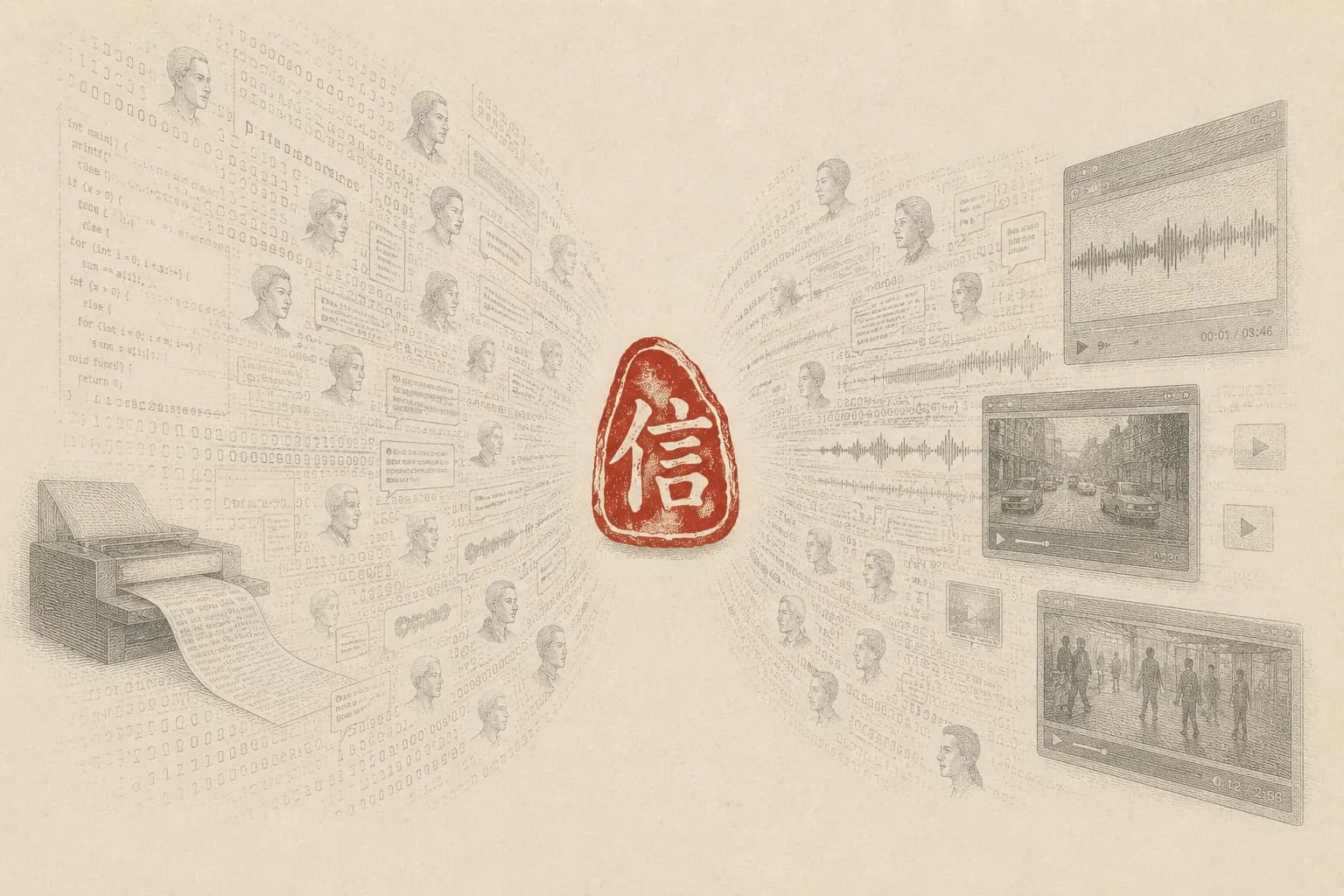
人而无信,不知其可也。 Rén ér wú xìn, bù zhī qí kě yě. “A person without trustworthiness — I cannot see what they are good for.” — Confucius, Analects 2.22
A paragraph of text. A face. A recording of something someone never said. A video you can’t tell from the real thing. The cost of producing all of these is collapsing toward zero.
Everything can be generated now, and a lot of people are unsettled by it: what’s still real?
I want to argue the reverse. Precisely because everything can be generated, one thing is quietly getting more expensive: trust. It is the one asset that can’t be generated.
1. When “what you can say” gets cheap, “what you can prove” gets expensive
Being articulate used to be scarce. Writing sharp copy, telling a compelling story, putting together a proposal that looked the part — these were valuable because not everyone could do them.
AI knocked the price of all that to the floor overnight. Looking professional is now almost free. Anyone can have a model produce a crisp analysis or an airtight pitch. Surface credibility is everywhere.
Economists call this a market for lemons: when buyers can’t tell good from bad, the bad drives out the good and overall quality spirals down. The market for content, and for talent, is going through the same thing. When anyone can pass as an expert, what an expert says stops being worth much.
So value flips over. It’s no longer about what you can say, but what you can prove. Saying is the machine’s home turf. Proving is where humans still compete.
2. Why trust can’t be generated
Trust isn’t a well-turned phrase, a certificate, or flawless copy. It is a function of time.
It’s built outward from people, one layer at a time. You trust your friends. You might trust a friend of a friend. Beyond that it thins out fast. And it rests on a record you can look back through: did this person do what they said they would?
That’s why you wouldn’t hand your retirement savings to a piece of code promising 1,400% annual returns. First you’d want to know whether there’s a real person behind it who won’t disappear. In the end, trust comes down to looking someone in the eye, and asking whether they’ll still be standing next to you a year from now.
There’s a clean dividing line here: you can use AI to dress up your abilities, but you can’t use it to dress up your character. Ability can be generated. Character can only be redeemed, like a promissory note. The first is a single output. The second is a long run of doing what you said, an account that takes years to fill.
3. Not an Eastern moral quirk — a classical consensus
You might assume that “trustworthiness” is Confucian moralizing, a particularly Eastern kind of sermon. It’s the opposite. Go back to the sources of the great classical civilizations and you find each of them, independently and in its own language, saying the same thing: trust is the ground that a person, and a livelihood, stand on.
China. The Book of Changes says: 修辞立其诚,所以居业也 (xiū cí lì qí chéng, suǒ yǐ jū yè yě): “Refine your words so that they rest on sincerity; that is how you secure your work.” Polished words are ci; a real person standing behind them is cheng, sincerity. Whatever you build your life on stands on the sincerity, not on the polish. Confucius put it more bluntly still: 民无信不立 (mín wú xìn bù lì), “Without trust, a people cannot stand.”
Greece. In the Rhetoric, Aristotle breaks persuasion into three parts: logos, persuading by reason; pathos, persuading by emotion; ethos, persuading by the character of the speaker. Of the three, he says, character is almost the most powerful. Whether people believe a sentence depends not just on how sound or moving it is, but on whose mouth it comes out of.
Rome. Latin has a word, fides: trust, good faith, keeping one’s word. Cicero wrote that “the foundation of justice is fides” (fundamentum iustitiae fides), and defined it as “constancy and truthfulness in what is said and agreed” — what you say and what you’ve promised, always matching up. And here’s the telling part: the English word credit comes straight from the Latin credere, to believe. Money is trust, solidified.
Israel. The book of Proverbs says: “A good name is rather to be chosen than great riches” (22:1). The Hebrew is simply שֵׁם, shem, “name.” Long before banks or credit scores, a person’s name was their entire credit account.
Four civilizations, separated by mountains and seas, not copying one another, all reaching the same conclusion. That isn’t coincidence. It’s humanity’s shared discovery about how people manage to cooperate at all: without trust, cooperation can’t even begin. And trust can only be accumulated by real people, over many years, by keeping their word again and again.
Now put AI inside this two-thousand-year-old consensus.
AI is the most powerful logos machine ever built, and increasingly a pathos machine too. It can make an argument watertight and pitch an emotion exactly right. But it can’t produce ethos, and it can’t produce fides, because character and good faith never lived in the words. They live in the speaker’s position: whether there’s someone standing behind the sentence who will keep the promise, answer for the consequences, and can’t just walk away. AI has all of the polish and none of the sincerity. It can fake the appearance of a good name, but not the ten years of real record that a good name stands for.
4. A signature proves “untampered,” not “trustworthy”
Someone will say: technology can fix this. Cryptographically sign every piece of content, trace it on a ledger, and you can tell real from fake.
That work is happening, but it only solves half the problem. A signature can prove that this text hasn’t been altered and that it really came from this account. It locks down the source. What it can’t lock down is the more important half: whether that source deserves to be believed.
A recording can be proven to be genuinely his voice. It can’t be proven to be true, or proven that he’ll follow through. The first is cryptography. The second is character: ethos, fides, a name built up over years. There’s no shortcut to it. You go back to the oldest method there is: look at whether this person did what they said before.
Technology can make “who said this” very cheap to establish. But “is this person reliable” has risen and fallen in value for two thousand years, and no technology has ever produced it out of thin air.
5. So treat trust as an asset to be managed
Once you see this, the way you work changes. Trust isn’t a marketing flourish. It’s an asset you manage over the long run.
Claim exactly what you have. If your ability is a twenty, say twenty, not eighty. In the short run you’ll lose some customers who wanted to be dazzled. In the medium run, repeat business, word of mouth, and reputation slowly fill a piggy bank. In the long run, the competitors propped up by exaggeration eventually disappear, and you’re still here. In a world of transparent information, easy returns, and bottom-up reviews, being honest about exactly what you’re worth is the strongest marketing there is.
Only promise what you can deliver. A promise equals product quality plus the ability to deliver plus the experience of service, and all three have to match. Before every expansion, before every bigger claim, ask: has my ability to deliver on this grown at the same pace? Saying what you can’t do is the fastest way to overdraw on trust. Wherever Cicero’s “constancy in what is said and agreed” breaks, that’s exactly where your credit leaks out.
Close every loop. Reliability isn’t a claim; it’s flagging the risk and offering a fallback before the deadline, not announcing at the deadline that it can’t be done.
The key point: trust is a slow variable. You can save it, but you can’t print it. It accumulates slowly and drains fast. Ten years of it can vanish in one scandal. It’s the same iron law as long-term thinking: going slowly is fine; going to zero is not.
In one line
In a world where everything can be generated, the one thing that can’t be is the most valuable asset of all.
The Chinese called it xin. The Greeks called it ethos. The Romans called it fides. The Hebrews called it a good name. Different words for the same thing: what a real person has earned by keeping their word for a lifetime, the quality of being worth believing.
Don’t compete with the machine on who can say more, faster, or more beautifully. That’s its home turf. Do the one thing it never can: make sure that behind every sentence you say stands a real, trustworthy you.
Leave the rhetoric to the machines. Trust, you have to earn yourself.
No spam. Unsubscribe anytime.