Essay
When the Machine Takes the Craft
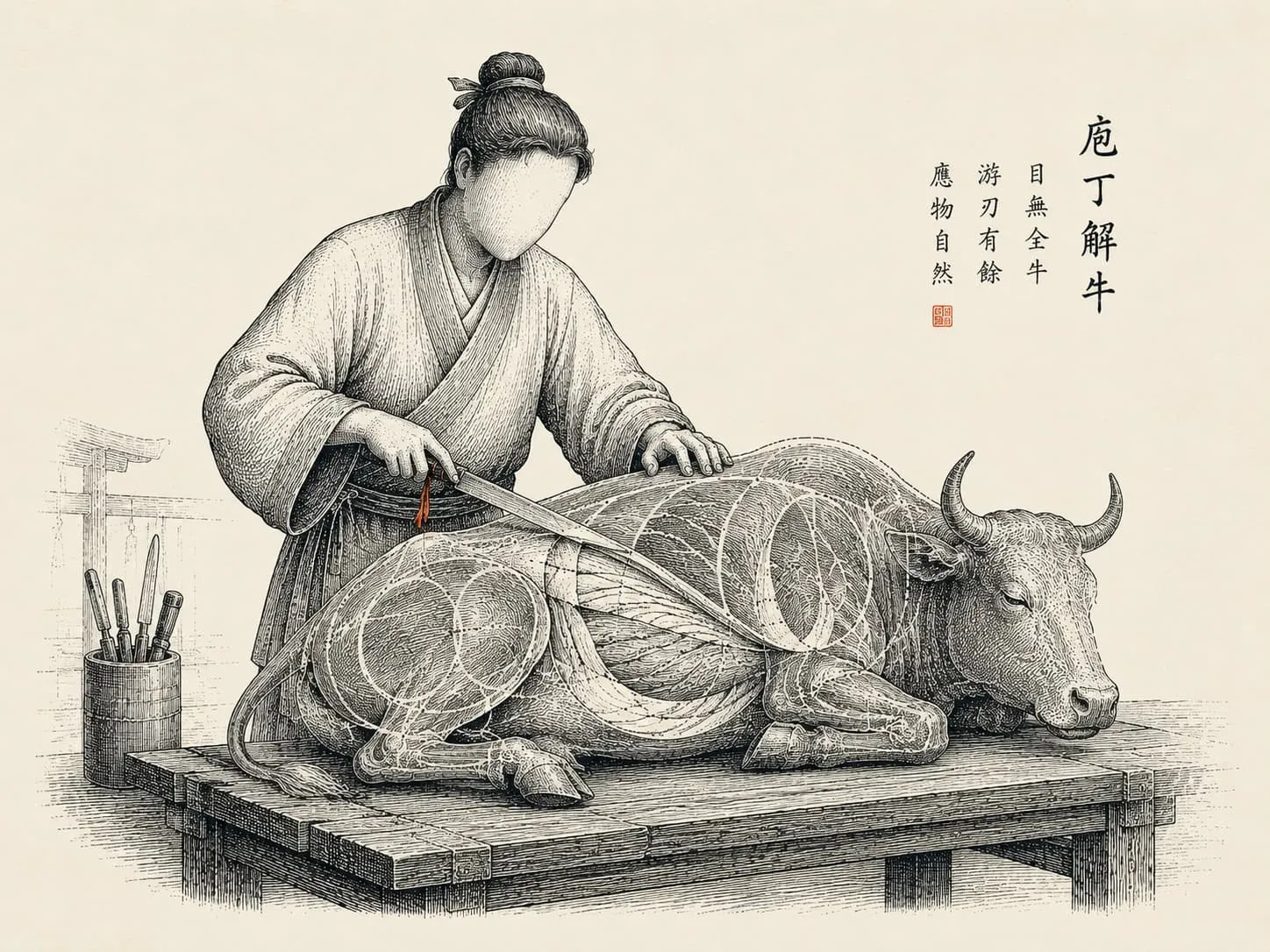
What I love is the Way, which goes beyond skill. — Zhuangzi, “Cook Ding Cuts Up an Ox”
Most people’s first reaction to AI is panic: “I spent ten years getting good at this, and it does it in seconds. So what am I worth now?”
The panic is understandable, but it asks the wrong question. More than two thousand years ago, Zhuangzi answered it — through a cook butchering an ox.
1. Skill and the Way: the classical hierarchy
Cook Ding carves an ox for his lord. The blade glides, flesh falls from bone, and the motions keep time like music. The lord is stunned: how did your skill reach this?
Ding sets down his knife: “What I love is the Way (dao); it goes beyond skill.” Nineteen years of butchering, and now he works “by spirit, not by eye” — he no longer looks, he understands the whole ox, and the blade finds its own way through.
East and West agree on this distinction.
The Japanese arts call the path shu-ha-ri (守破離): first obey the form (shu), then break it (ha), then leave it and make it your own (ri). Shu is skill; ri is the Way. In the West, Hubert Dreyfus’s model of skill acquisition describes the same arc: the novice follows rules; the true expert has dissolved the rules into intuition — he no longer thinks, he knows. Richard Sennett’s The Craftsman tells the same story.
The ancients, across traditions, said one thing: skill is the necessary road, but not the destination; the Way — judgment, intuition, knowing-why — is.
2. What AI climbs is exactly the “skill” rungs
Look at what AI is good at: execution that can be formalized, repeated, scored against a standard.
A programmer’s boilerplate, a designer’s production work, a translator’s first pass, a radiologist’s first read, a lawyer’s research, a writer’s rough draft — what AI takes over is precisely the rungs of skill. It has flattened the “practice makes perfect” layer of almost any craft.
So the first judgment surfaces: AI hasn’t made mastery worthless. It has made skill worthless and pushed the Way — taste, judgment, knowing what to do and why — into the decisive position. Whether you can judge what’s worth doing, and whether it’s any good, is suddenly the only thing that separates people.
The old hierarchy went, overnight, from philosophy to survival rule.
3. This isn’t liberation. It’s a sorting.
The popular line: “AI automates the boring parts and frees us for creative work.”
Too naive.
Climbing toward the Way is hard, and it can’t be automated. Worse, many people’s identity and livelihood are built on skill — on being faster, more accurate, more thorough than the next person. AI doesn’t gently free them; it sorts them: those who can climb to the Way see their value soar; those stuck at skill get replaced.
That’s not a motivational slogan. It’s already happening.
4. The broken ladder
But the real danger sits one level lower, and almost no one names it.
Cook Ding’s Way grew out of nineteen years of skill. “Working by spirit” was built on countless repetitions of “working by eye.” Shu-ha-ri is the same: you must drill shu into the ground before you can ri. Judgment has no shortcut — it has always been a by-product of repeated labor.
So here’s the question: when AI does all the skill for newcomers, when they never again grind through that clumsy apprenticeship — how do they reach the Way?
The lower half of the ladder has been pulled away.
This could raise a generation with neither skill nor Way: fluent at summoning AI’s craft, yet never having grown judgment through rounds of choosing, erring, and redoing. They can get a result, but can’t tell what’s good about it, or what’s wrong.
I call this the broken ladder. The most underrated risk of the AI age isn’t that the machine is too strong — it’s that people have lost the road to the Way.
5. Make “reaching the Way” a deliberate practice
If the route of “drill skill until enlightenment arrives on its own” is gone, then the Way has to be cultivated on purpose, not left to grow by accident.
Concretely:
- Still live through some skill — not for output, but to grow judgment. Even when AI can do it, do a few rounds by hand, because feel and judgment only grow through doing.
- Practice choosing on AI’s drafts — judgment grows in the act of “keep this, kill that.” Treat AI as the one who sets the problem; you make the choices.
- Always ask “so what” — push from “I know this” to “here’s what I now think — and what I’ll do or change because of it.”
- Read the classics, cultivate taste — feed the Way actively, instead of letting it starve.
This is really the old idea of wen yi zai dao — writing exists to carry the Way. Skill (the writing) always served the Way. It’s just that, in the past, the two were learned together; now that AI has pried skill loose, we have to make room — separately and deliberately — to cultivate the Way.
Coda
Back to that cook. “What I love is the Way,” he said.
AI can take the knife-work; it can’t take the heart that loves the Way. But it reminds us of one thing: skill can be folded away; the Way must be lived through. When the machine takes the skill, a person’s only path is upward, to the Way — and that path the machine will neither walk for you, nor pave anymore.
From here, you climb on your own.
No spam. Unsubscribe anytime.