Essay
Building a Brand When Content Is Free
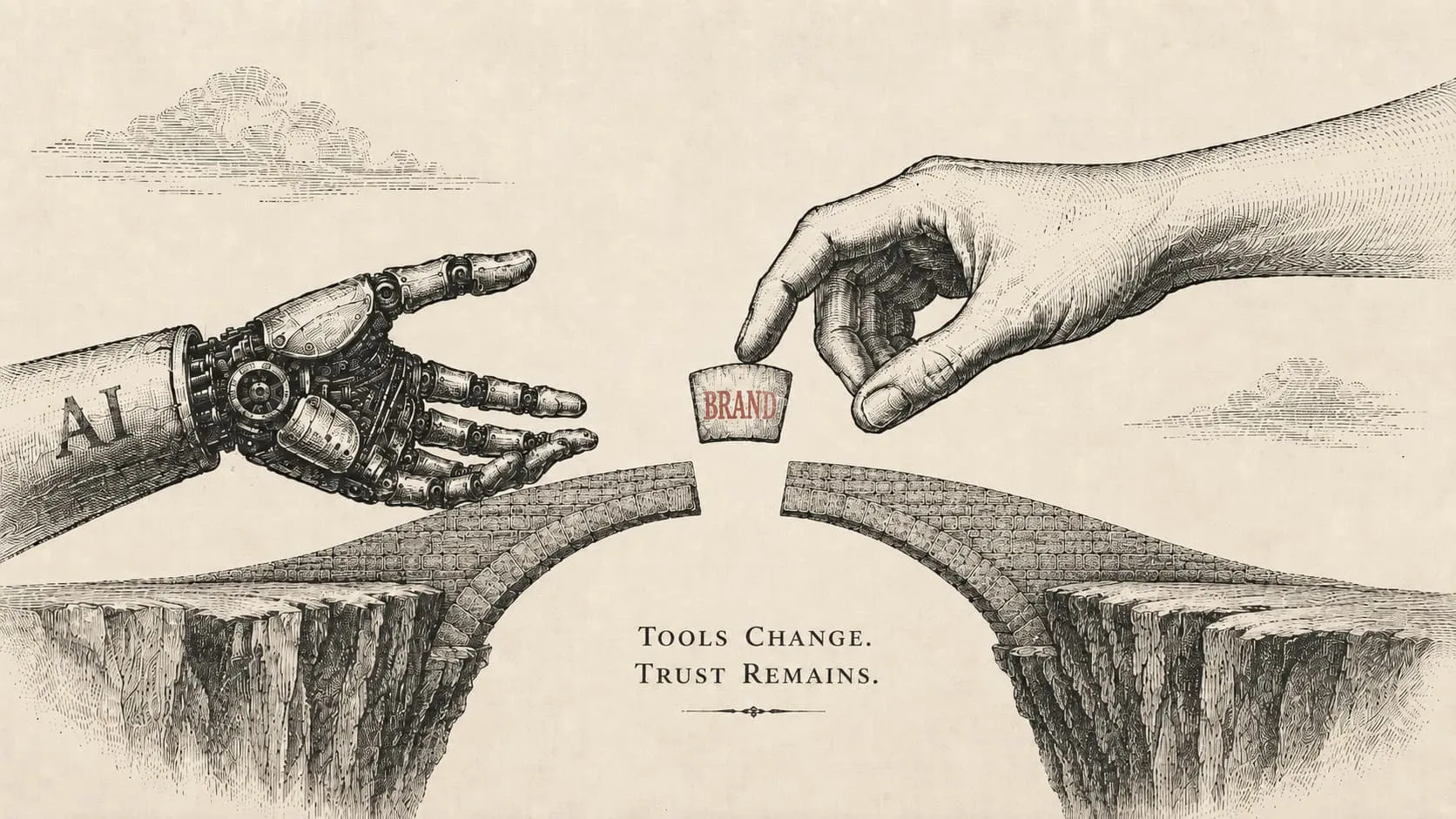
I deliberately kept “AI” out of the title. “The age of AI” is already a worn-out phrase, and it tends to make everything sound like it’s starting over from zero. But strip away the hype and one concrete thing really has changed: AI drove the marginal cost of producing content to near zero. That single fact is what’s worth thinking through — what it changes about brand-building, and what it doesn’t.
I. First, see clearly what doesn’t change
The first thing to do when discussing brand-building in the age of AI is, paradoxically, to set “change” aside for a moment.
A brand, at its core, is the network of associations attached to a name in a consumer’s mind. Keller calls it brand knowledge structure; the Ehrenberg-Bass school puts it more bluntly — a brand is the set of “mental availability structures” in the brain. This hasn’t changed from the Coca-Cola era to today.
Costco is a useful example. No clever AI, no viral campaign. It simply did a few simple things — fair prices, a no-questions-asked return policy, treating employees decently — consistently, for decades. The result is a position in the public mind that no competitor can buy back at any price: the retailer you can trust. (China has its own version of this in Pang Dong Lai, a regional chain that became a national phenomenon on exactly the same foundation — three decades of not cutting corners.)
The human brain has not upgraded to version 2.0. We still rely on fuzzy memory, emotional connection, social proof, and recognizable visual symbols to make buying decisions. However powerful AI becomes, it ultimately faces this same set of human cognitive mechanisms. Any argument that treats AI as a reset button underestimates the stability of human cognition.
So the first principle is plain: in the age of AI, don’t forget you’re still dealing with people.
II. So what actually changes
But to say nothing has changed is its own kind of evasion. AI’s changes are real, and they happen at a few fundamental layers.
First, discovery is being rebuilt. For a decade, people found answers through search engines. Now, more and more ask an AI directly. Open Perplexity and ask “which electric car should I buy under $30k,” and you don’t get ten blue links to sift through — you get a structured comparison, with price, range, and reputation already organized. Since Google rolled out AI Overviews, multiple studies have observed click-through rates on results being pushed down. The value of being the #1 link is depreciating; the value of being the name the AI folds into its answer is appreciating.
Second, content supply has flooded. Generative AI drove the marginal cost of producing content to near zero. A small company can churn out hundreds of decent-looking posts a day, and the result is a web full of content that “seems fine but leaves nothing behind.” In that environment, content that is true, distinctive, and shows judgment becomes the scarce good. The real currency of attention shifts from volume to signal strength.
Third, the relationship at the touchpoint is being reshaped. Brands used to reach users through ads, retail, and support. The age of AI adds a new intermediary — the model itself. Someone choosing a SaaS tool might not visit a single website first; they ask an AI “what’s the best collaboration tool for a mid-sized team,” then check the top three. The AI has become a new channel through which brands reach users. How a brand is understood by AI starts to matter as much as how it’s understood by people.
III. What the new methodology looks like
Once those shifts are clear, the methodology follows.
1. Make your brand assets machine-readable
This isn’t a technical task — it’s a strategic one.
The best example is Stripe. The payments-infrastructure company has accumulated its developer docs, product blog, and founder essays (Patrick Collison’s reading lists and long interviews) to a near-academic standard. The result: ask any large model today for “best practices in online payments,” and Stripe almost inevitably appears in the answer. It didn’t outspend its rivals on ads — it made itself the AI’s default reference in its domain. HubSpot did it for inbound marketing; Notion did it through its template ecosystem. Same path: by accumulating structured, searchable, citable public knowledge, they entered the AI’s default answer set.
Xiaomi does a version of this too, by different means. Lei Jun’s annual keynote is essentially a structured deposit of brand narrative — company story, product philosophy, and cultural stance, made public in a form that can be quoted, retrieved, and spread. When a new product launches, AI, media, and users all have a coherent, ready-made narrative to understand it through.
2. Shift from “campaign” to “continuous conversation”
Brand-building used to be measured in campaigns — a few big battles a year. But attention in the age of AI is continuous, long-tailed, and conversational.
Duolingo is the interesting case. What it does on TikTok isn’t ad placement — it’s letting its green owl mascot show up in front of users every day, chasing trends, making jokes, rarely selling courses directly. The result is a share of mind among young users far beyond brands that spend more on formal campaigns. Wendy’s built the same kind of asset through its irreverent presence on X. This “being there,” accumulated over time, becomes an asset competitors can’t buy.
The counter-lesson: plenty of brands spend heavily on campaigns with celebrity casts, but lacking the capacity for continuous conversation, the warmth fades the moment the campaign ends.
3. Treat trust as the most important brand asset
AI hallucination, deepfakes, and a flood of mixed-quality content are all eroding the credibility of information. In that environment, whoever can be a reliable, repeatedly-verified, never-disappointing source owns a genuinely scarce resource.
The collapse of Bud Light’s standing in 2023 is worth studying. A single misjudged moment, amplified relentlessly, erased brand equity built over years — in a matter of weeks. The information speed of the AI era only accelerates this kind of trust collapse: one bad experience can be cited and re-cited across thousands of AI answers within 24 hours, hardening into the model’s default description of the brand.
Costco, by contrast, stacks every move in one direction: making trust an un-copyable moat. That kind of asset is something AI can’t compute — but will reliably recommend.
4. Come back to people
This sounds counterintuitive, but the more AI-saturated the environment, the scarcer human warmth, judgment, and conviction become.
When Yvon Chouinard gave Patagonia away to fight climate change — “Earth is now our only shareholder” — no AI could have planned that move. But it’s exactly that kind of human, conviction-driven act that gives a brand a distinctiveness no competitor’s content engine can replicate.
The questions brand-building ultimately has to answer aren’t “how do we use AI to produce more content,” but “what does this company actually believe, stand for, and exist for.” AI can’t answer those. People have to.
Coda
AI won’t replace the logic of brand-building, but it will rewrite the method. The hard part isn’t learning the new tools — it’s thinking clearly about what must be held onto and what must be let go.
Brand-building is, in the end, a slow thing — too slow to be accelerated by an algorithm, slow enough that it has to be built with time and sincerity. However powerful AI gets, it can’t walk this road for us. But it can tell us this: the road is more worth walking, carefully, than it was before.
No spam. Unsubscribe anytime.