Essay
Bayesian Humility: An Ancient Virtue, Now in Formula Form
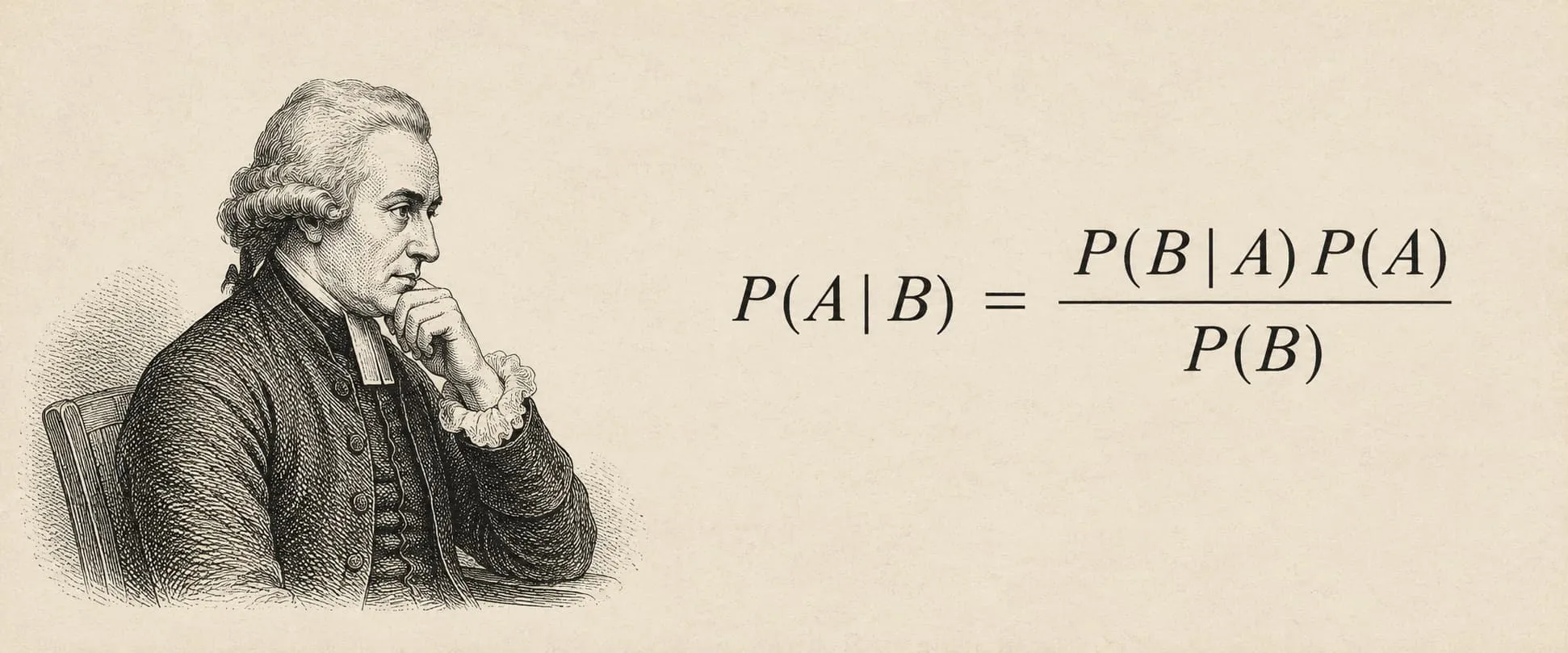
When you know a thing, hold that you know it; when you do not, allow that you do not know it — this is true knowing. — Confucius, Analects, II.17
In the 18th century, an English Presbyterian minister named Thomas Bayes worked out, in his spare time, a way to reason “backward from outcomes to causes.” He apparently didn’t think much of it and never published. Only after his death did his friend Richard Price find the essay among his papers and have it published, in 1763.
For nearly two centuries the idea was dismissed, even mocked, by mainstream statistics. Yet in private it kept performing the impossible. In WWII, Alan Turing leaned on it to help break the Enigma; later it was used to locate a lost nuclear submarine and a hydrogen bomb that had fallen into the sea. There’s a whole book about it — The Theory That Would Not Die.
A one-line idea, almost left to gather dust in a vicar’s drawer, now underpins spam filters, medical diagnosis, and all of modern AI. And its core is far older than mathematics: when the evidence changes, change your mind.
1. So what is this “one-line idea”?
Bayes’ theorem is just the mathematical form of “update your prior belief with new evidence”:
Don’t be intimidated; piece by piece it’s plain:
- — the prior: how likely you thought was, before seeing the evidence;
- — the likelihood: if were true, how likely would you see the evidence ;
- — the total probability of seeing (the normalizer);
- — the posterior: your updated belief after seeing the evidence.
A counter-intuitive example. A disease has 1% prevalence; a test is 99% accurate (99% of the sick test positive, 99% of the healthy test negative). You test positive. What’s the probability you actually have the disease?
Intuition shouts “99%.” But work it out. In every 10,000 people, the 100 actually sick yield about 99 positives; the 9,900 healthy yield about 99 false positives. The two sides are nearly equal, so the chance you really have the disease is only about 50%.
Intuition is wildly off because it forgot the prior — that “healthy people are far more numerous.” Already, the seed of the whole essay: believing correctly takes not cleverness but the willingness to weigh priors and base rates honestly — a kind of humility.
2. It is only an ancient virtue put into a formula
Bayes’ theorem was written down in 1763. But what it says, the ancients had said much earlier — without formulas, with stories.
In the Analects, there’s a scene. Confucius says to his disciple Zilu: Yóu, let me teach you what it means to know — to know what you know, and to know what you do not know; that is what knowing is. It was aimed at Zilu’s habit of bluffing his way through. What Confucius wanted him to change wasn’t his knowledge but his honesty about it.
Socrates has the more dramatic version. The oracle at Delphi declared that no man was wiser than him. Socrates was puzzled — he knew nothing, he thought. So he went around Athens questioning men reputed for wisdom, and found they didn’t really know much either; they only thought they did. That’s when he understood the oracle: his one advantage was knowing his own ignorance.
Eighteen hundred years later, Montaigne had the same thought carved into his study. On a balance-shaped medal he struck the question — “Que sais-je? (What do I know?)” — and he filled his entire Essais with the same doubt: every judgment weighed three times before it was made.
Three civilizations, separated by millennia and oceans, arrive at the same point: wisdom begins with admitting you might be wrong. That is the soul of Bayes — the prior is only “for now”; once evidence arrives, it has to change. The ancients didn’t lack the insight; they lacked the one line that made it precise.
3. The hard part was never the arithmetic; it’s the ego
There’s a cruel asymmetry here.
Bayes’ formula is one line — any high-schooler can compute it. The hard part is being willing to update — because admitting you’re wrong doesn’t threaten the numbers, it threatens your face, your position, your identity. Psychology has names for the “conclusion first, reasons second” disease: confirmation bias, motivated reasoning. We aren’t usually chasing the truth — we’re defending the self we’ve already become.
The history of medicine has a chilling example. In 1840s Vienna, Ignaz Semmelweis discovered that if obstetricians simply washed their hands with chlorinated lime before delivering babies, maternal mortality dropped from over ten percent to single digits. The evidence was unambiguous. His colleagues, instead of changing, attacked him — because the conclusion implied that they themselves, with “cadaverous particles” clinging to their unwashed hands, had been killing the women. That was unswallowable. The hand-washing protocol was resisted for decades; Semmelweis was ostracized, lost his job, and died in an asylum.
The evidence was fine. The math was fine. What stuck was a group of people unwilling to let themselves be wrong. And the more invested, the more public, the more famous the position, the harder the change — because what has to be overturned is half of who they are.
So a not-so-obvious judgment surfaces: we turned an ancient virtue into a formula and then forgot — the formula was never the hard part. Updating is easy; being willing to update is a lifetime’s discipline.
4. The best forecasters win on humility, not on intellect
This isn’t moral exhortation. It’s data.
The psychologist Philip Tetlock spent years tracking the predictions of political and economic experts. The result is humbling: their accuracy was about that of a “dart-throwing chimpanzee.” And the more often they appeared on television, the more emphatically they spoke, the more reliably wrong they tended to be.
Later, in the Good Judgment Project, he sifted through tens of thousands of ordinary people and isolated a small group of “superforecasters.” They aren’t the smartest, or the most credentialed. What they share is a temperament: they are foxes, not hedgehogs — they don’t bet on one big conviction; they break judgments into probabilities and make small updates often. Today they call something “60% likely”; a news item nudges it to 63%, then to 58%.
They live, in other words, in the shape of Bayes’ formula. Humility, here, isn’t moral garnish; it’s a measurable predictive edge.
5. Even our machines lack “knowing what they don’t know”
Curiously, our own creations have the same vice.
In 2023, a New York lawyer used ChatGPT to draft a brief. It cited six cases that didn’t exist — with names, parties, and docket numbers, all delivered with a straight face. The lawyer filed without checking and was sanctioned. The model wasn’t ignorant; it didn’t know that it didn’t know, and asserted anyway. This is what we call “hallucination” — at heart, false confidence.
Teaching an AI to “know what it doesn’t know,” to actually say “I’m only 40% sure about this,” is still an unsolved problem. That even our most advanced intelligences can’t clear this bar tells you how scarce, and how hard, this 2,500-year-old virtue really is.
6. Knowing it and doing it are two different things
The ancients saw it clearly. Did they live up to it? Rarely.
Knowing one should be humble and being able to be humble are different things. Confucius himself sighed that those truly fond of learning were few. Virtue has always been easier to articulate than to enact — Bayes can’t swallow the lump of “I was wrong” for you.
The people who actually managed it had to fight their own instincts. Charles Darwin had a “golden rule”: whenever he encountered a fact at odds with his theory, he forced himself to write it down immediately — because he had noticed that such inconvenient evidence “escapes the memory more readily than the agreeable kind.” This wasn’t talent; it was a piece of deliberate discipline against the self.
So the classics offer no off-the-shelf solution. But they got the right problem: whether you can believe correctly is a matter of character, not intelligence. In an age awash in opinions, where everyone is certain and even AI rushes to hand you a confident answer, this old virtue has become the decisive scarcity.
Coda
Bayes compressed an ancient virtue into a single line. The formula can be taught to a machine in an afternoon; the virtue takes a lifetime — and most people, and the strongest machines, still haven’t learned it.
The physicist Max Planck once said, coldly: “Science advances one funeral at a time.” A new theory wins not because its opponents are persuaded but because they age and depart — they can’t be made to update, only outlived. If even science can’t count on this virtue, you can imagine how scarce it is.
But scarce is exactly why it’s the watershed of this age. When answers are cheap, certainty is free, and even AI is racing to hand you the verdict — the rarest, most human act is to stop and say: “I might be wrong.”
Two thousand years on, the old line still holds: knowing that you don’t know is where knowing begins. Bayes can compute how much you should believe; whether you’re willing to accept that — and act on it — isn’t calculation. It’s cultivation.
References
Classical sources
- Analects II.17 (Confucius) — “To know what you know and what you do not — this is knowing.”
- Plato, Apology — Socrates and the Delphic oracle
- Montaigne, Essais — “Que sais-je?”
Modern
- Thomas Bayes / Richard Price (1763), An Essay towards solving a Problem in the Doctrine of Chances
- Sharon Bertsch McGrayne, The Theory That Would Not Die — the two-century saga of Bayes’ rule
- Philip Tetlock, Expert Political Judgment & Superforecasting — “dart-throwing chimpanzees,” foxes vs. hedgehogs, the superforecasters
- Ignaz Semmelweis and the hand-washing controversy — a textbook case of clear evidence rejected on grounds of pride
- Charles Darwin, Autobiography — the “golden rule” of recording disconfirming facts
- Mata v. Avianca (2023) — a lawyer sanctioned for citing ChatGPT-fabricated cases
No spam. Unsubscribe anytime.